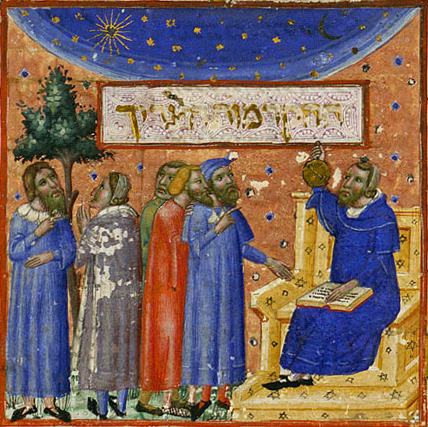
Moses Maimonides

Moses Maimonides (1135–1204), Rabbi Moshe ben Maimon (Rambam), was the most influential Jewish thinker since the Moses of the Bible or Torah.

Moses Mainmonides as found in The Wonder of the WorldThe following are excerpts from the book The Wonder of the World: A Journey from Modern Science to the Mind of God by Roy Abraham Varghese. Used with permission.

"Varghese skillfully leads us through a scientific and philosophical description of our magnificent universe. Experiencing the wonder of our world is the surest path to realizing that a purely materialist answer to that question is both scientifi cally and philosophically inadequate."
Gerald Schroeder: Israeli scientist and author of The Hidden Face of God: How Science Reveals the Ultimate Truth
more reviews

From page 70:
Every thousand years or so, there comes a thinker whose life is as striking as his or her intellectual output is stunning. Viewed from this perspective, it is remarkable indeed that within a period of 300+ years, the world was to witness the convergent odysseys of four titans of thought who set the agenda for the study of reality at every level. This is the period I like to call the Golden Age of human thought. Between them, Avicenna of Persia (980–1037), Moses Maimonides of Egypt (1135–1204), Thomas Aquinas of Italy (c. 1225–1274) and Madhvacharya of India (c. 1238–1317) created a magnificent monument of thought that underpins the very possibility of the scientific enterprise. It was the mother of all Theories of Everything, one that was validated both by its inherent logic and the success of modern science.

From page 12:
My thesis is that the foundational framework of modern science, with the key idea of laws of nature, was born and bred in the theistic world-vision. What is more, prior to this and within a time window of 300 years, the four finest thinkers of Hinduism, Judaism, Christianity and Islam framed a meta-scientific Theory of Everything that underpins the scientific enterprise. This intellectual superstructure, which we shall call the Matrix, provided a systematic rationale for the foundations of science. Its starting-point and core principle was an “equation of God.” Interestingly the great scientists who founded modern science, Copernicus, Newton, Maxwell, Einstein, Planck, Heisenberg, Dirac and numerous others, were Prophets of the Matrix in the sense that they passionately proclaimed the root-and-fruit embeddedness of science and religion. The Matrix is the common platform that supports both science and religion.

From page 114 to 116:
Moses Maimonides (1135–1204), Rabbi Moshe ben Maimon (Rambam), was the most influential Jewish thinker since, well, Moses. A Jewish saying makes this very point: “From Moses [of the Torah] to Moses [Maimonides] there was none like Moses.” Born in Córdoba, Spain, he fled to Morocco and then settled down in Egypt after the intolerant Almohads gained power. In later life he became the court physician of the Sultan Saladin and the head of the Jewish community in Cairo. Maimonides’ most famous work is Guide to the Perplexed, an explanation of God’s infinite perfection addressed to a disciple who was troubled by disputes in philosophy and theology. He also authored several classic works of Jewish law and scriptural commentary.

From the present standpoint, Maimonides’ perspectives on God, the world and human reason are of special interest:

“As for that which has no cause for its existence, there is only God...His existence is necessary. Accordingly, His existence is identical with his essence, and his true reality, and his essence is his existence.”

In his Commentary to the Mishnah, he says, “God is the Being, perfect in every possible way, who is the ultimate Cause of all existence. It is inconceivable that God does not exist, for if God did not exist, everything else would also cease to exist and nothing would remain. Only God is totally self-sufficient and, therefore, Unity and Mastery belong only to God.”

God, writes Maimonides, “is one in all respects; no multiplicity should be posited in Him...the numerous attributes...that figure in the Scriptures and that are indicative of Him...are mentioned in reference to the multiplicity of His actions and not because of a multiplicity subsisting in His essence.” In other words, God is Creator of all things and eternal. In Part 2 of the Guide, Maimonides gives 26 propositions that demonstrate the existence of God and his attributes of being One and without a body.

God created the world from nothing. Maimonides admits that creation is not provable from reason. But the eternal existence of the world is similarly unprovable. Creation, however, is more likely because it is compatible with God’s freedom and is a better explanation of how the multiplicity of the world could originate from the unity of the divine.

By showing that the Creator is infinite Intelligence, he provided a solid foundation for our belief that the universe and its laws are rational:

“We believe that the Universe remains perpetually with the same properties with which the Creator has endowed it, and that none of these will ever be changed except by way of a miracle in some individual instances, although the Creator has the power to change the whole Universe, to annihilate it, or to remove any of its properties. The Universe had, however, a beginning and a commencement, for when nothing was as yet in existence except God, His wisdom decreed that the Universe be brought into existence at a certain time, that it should not be annihilated or changed as regards any of its properties, except in some instances; some of these are known to us, whilst others belong to the future, and are therefore unknown to us.”

Unlike pantheists and monists, Maimonides held that God totally transcends the world. This avowal has enormous consequences. While Aristotle’s idea of purpose was focused on the purposive structures in the world, Maimonides argued that a true purpose for the universe could only come from something outside it. Since God transcends the universe, he can give an overarching purpose to the universe as a whole. Interestingly, his greatest Jewish antagonist in subsequent centuries was the pantheist Baruch Spinoza.

Like most theists, Maimonides believed that none of our verbal descriptions adequately describe God. He emphasized the negative approach to God’s attributes. We speak of them more in terms of what they are not; for instance, God is not limited by time or by space. The attributes of God catalogued in the scriptures, he said, “are mentioned only to direct the mind toward nothing but His perfection [or]...are attributes referring to actions proceeding from Him.”

Maimonides had a positive view of the mind’s ability to discover truth. He held that there could be no conflict between the truths we discover in science and philosophy and the truths we believe to be revealed from God. He also did not believe that religious authorities could answer scientific questions. The human intellect reaches the summit of its powers, said Maimonides, when it studies God, who is absolute, pure Intelligence, since the ultimate goal of life is to know God and love him. We enhance our intellectual growth by studying nature and mathematics, and in fact we come to know God better precisely through these endeavors. But to be truly fulfilled we must also aspire to moral perfection.

To find out more about Moses Maimonides and the "Theory of Everything" he shares in common with Avicenna, Aquinas and Mahdvacharya, read the book The Wonder of the World: A Journey from Modern Science to the Mind of God by Roy Abraham Varghese.


Further resources on Maimonides: